

(A Nigerian NewsLeader Editorial, Monday, November 2, 2026)
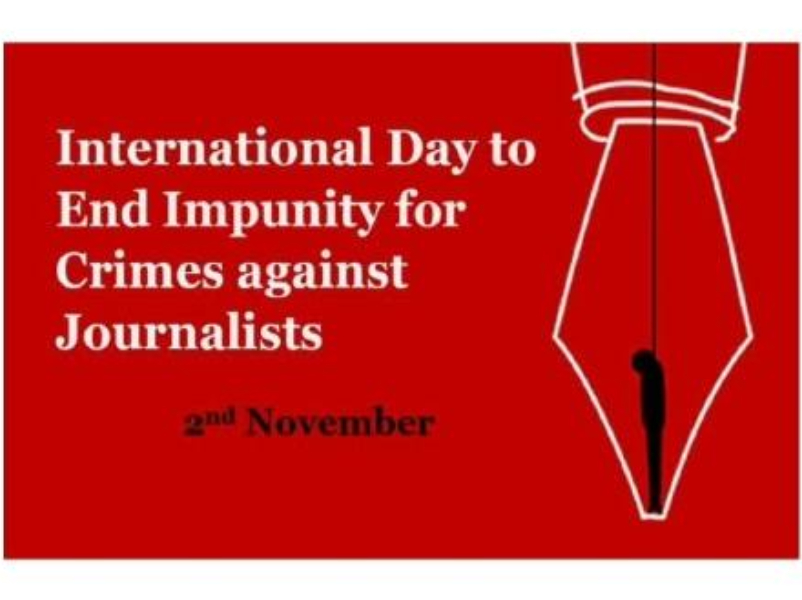
Every year on November 2, the world marks the International Day to End Impunity for Crimes against Journalists (IDEI).
It is a date that carries the weight of a double tragedy. On this day in 2013, two French journalists, Ghislaine Dupont and Claude Verlon, were abducted and assassinated in Mali while on assignment.
Their murders, like thousands before and since, were not merely acts of violence against two individuals, they were an assault on the public’s right to know. The United Nations General Assembly established the day in 2013 to demand accountability, yet more than a decade later, the scale of the problem has only grown more grave.
This year’s commemoration, observed under the theme “Chat GBV: Raising Awareness on AI-facilitated Gender-Based Violence against Women Journalists,” forces us to confront both the old, entrenched impunity for physical violence and the emerging, insidious threats of digital repression. The core message remains that when journalists are killed, attacked, or silenced with impunity, democracy itself is the casualty.
The global statistics paint a horrifying picture of a profession under siege. According to the latest UNESCO report, 189 journalists and media workers were killed worldwide in 2024 and 2025, a 20 percent increase from the previous biennium and the highest toll since 2014-2015. More than two-thirds of these killings, some 127, occurred in conflict zones, where the line between battlefield and newsroom has catastrophically blurred.
The use of drones has emerged as a particularly disturbing threat, with 50 journalists killed in drone strikes during this period. Yet the most damning statistic is not the number of deaths, but the number of unanswered questions.
The global impunity rate for journalist killings has risen to 86 percent. In conflict settings, UN Secretary-General António Guterres noted that impunity is “close to 100 percent”. This means that in the vast majority of cases, those who murder journalists are never identified, prosecuted, or punished.
This impunity is not confined to war zones alone. The International Federation of Journalists (IFJ) documented 128 media professionals killed in 2025 alone, with the Middle East and Arab World accounting for 58 percent of the toll, primarily due to the war in Gaza. In Africa, the situation remains perilous. While UNESCO’s verified data for the 2024-2025 biennium lists six killings in Africa, the IFJ’s broader annual count recorded 18 journalists killed on the continent in 2025, including seven accidental deaths in Nigeria and one in Burundi.
Sudan, for the second consecutive year, was the deadliest country for journalists in Africa, with at least six killed in relation to their work, often targeted in drone strikes by paramilitary forces. Each of these deaths represents not only a story untold but a corruption unmasked and a truth buried.
For Nigeria, the IDEI is not an abstract commemoration but a stark indictment of the domestic security and justice architecture. The Media Rights Agenda (MRA) documented 86 separate incidents of attacks against journalists, media houses, and citizens in 2025 alone, a figure that reveals a deteriorating environment for free expression. The report, aptly titled “The Reign of Impunity,” found that not a single case resulted in a successful investigation or prosecution, even where the actions constituted clear criminal offences.
The perpetrators are not shadowy figures at all. The Nigeria Police Force was identified as the worst offender, responsible for 41 incidents, and nearly 48 percent of all attacks, followed by the Department of State Services (DSS). Arrests and detentions were the primary tools of suppression, with 38 documented cases, while physical assaults accounted for 21.
The report further highlighted the weaponization of the Cybercrimes Act of 2015 to target journalists and the deployment of digital surveillance tools to monitor them. When the guardians of law and order become the primary violators, the message to journalists is that their safety depends not on their rights, but on the whims of those in power.
This year’s IDEI theme draws urgent attention to a frontier where violence is not always physical but can be equally devastating. Women journalists are increasingly exposed to AI-driven threats such as gendered disinformation, surveillance, deepfakes, and coordinated online harassment. UNESCO’s research reveals that 73 percent of women journalists have faced online threats, with one in four experiencing offline attacks as a direct result.
In Zimbabwe, 63 percent of surveyed women journalists reported technology-facilitated gender-based violence, including hate speech and doxxing. This digital abuse is not a side issue but a deliberate strategy to drive women out of public discourse and to chill free expression as well as to silence the perspectives that are essential to a functioning democracy. Impunity in the digital realm is just as corrosive as impunity for murder. It tells perpetrators that there are no consequences for driving a journalist into fear, self-censorship, or exile.
The solutions are neither mysterious nor beyond reach. They require political will, legal reform, and sustained international pressure. Governments, starting with Nigeria’s, need to move beyond rhetorical commitments to the UN Plan of Action on the Safety of Journalists and translate them into enforceable domestic law. This means reviewing relevant legislation to introduce stiffer penalties for attacks on journalists and ensuring that existing laws, such as the
Cybercrimes Act, are not misused as tools of intimidation. It means guaranteeing the independence of investigations and prosecutions, so that a police officer who assaults a journalist is held to the same standard as any other offender.
Law enforcement and security agencies urgently need to undergo mandatory training on press freedom and the constitutional rights of journalists. Media organizations, for their part, must invest in the safety of their staff, providing protective equipment, digital security training, and robust legal support, particularly for women journalists facing online threats. Tech platforms should be held accountable for the AI-facilitated abuse that festers on their services, with transparent and enforceable policies to protect journalists from coordinated harassment and deepfake attacks.
Also, the international community must support the IFJ-led call for an International Convention on the Safety and Independence of Journalists, creating a binding framework that closes the gaps in existing protections.
The IDEI is both a day of remembrance and a day of reckoning. Every unsolved murder or unpunished assault, and every woman journalist driven offline by a deepfake is a crack in the foundation of democracy. Impunity is not merely a failure of justice but an invitation to further violence and a signal that the truth-tellers are fair game.
As UN Secretary-General, Guterres, warned that this is “a heinous affront to the victims and their loved ones, as well as all of us who depend on journalists to remain informed and engaged”.
The world cannot afford the silence that impunity breeds. On this November 2, 2026, the demand, simply and absolutely, is an end to the impunity against journalists. They should be protected. NNL.