


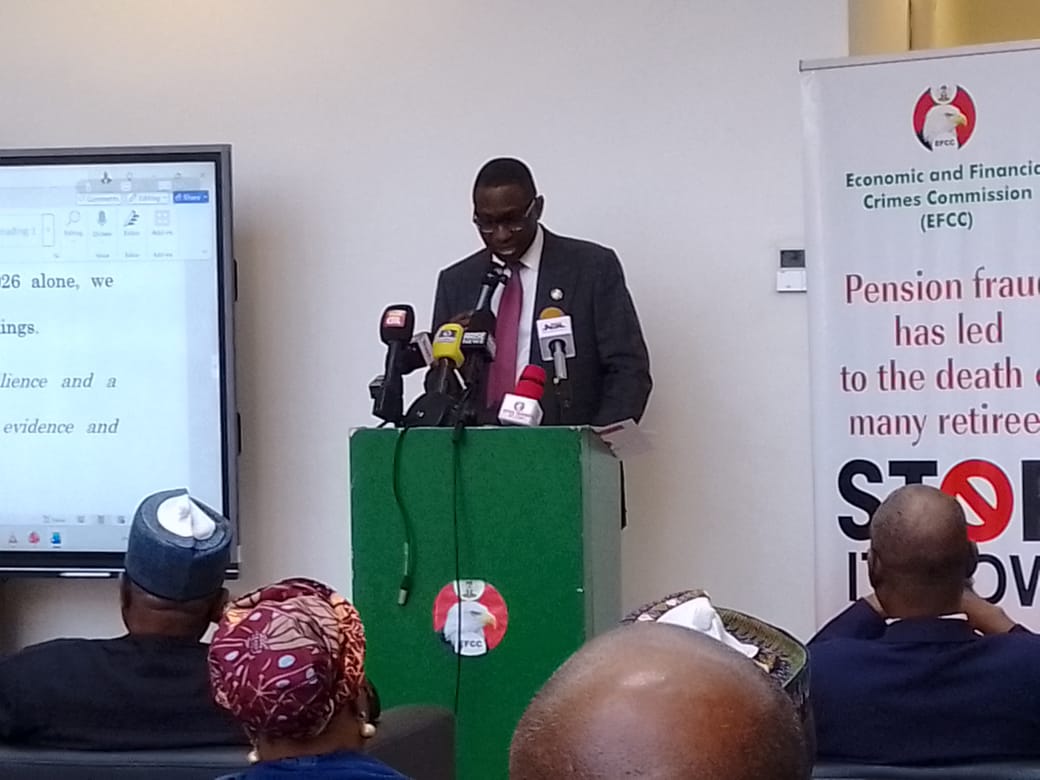
(A Nigerian NewsLeader Newspaper Review of Three Years of EFCC Under Barrister Ola Olukoyede)
- Agency Recovered N1.23 Trillion, Secured 10,872 Convictions In The Leadership Period Under Review
By Celestine Okafor (Editor-in-chief)
When a young, ebullient and firm attorney of law, Ola Olukoyede Esq, took the helm of affairs of the Economic and Financial Crimes Commission (EFCC) in October 2023, he promised a different approach.
Olukoyede assured his listeners and worried Nigerians about the high corruption level in the country, that he would convert petitions into prosecutions, prosecutions into recoveries, and recoveries into tangible national impact. Thirty-four months later, the numbers apparently tell a compelling story.
Between October 2023 and July 2026, the EFCC received 49,673 petitions, investigated 39,615 cases, filed 14,476 cases in court, and secured 10,872 convictions—a conviction-to-filing ratio of 75.1 per cent. In the first half of 2026 alone, the Commission recorded 1,370 convictions from 1,889 filings.
These aren't mere statistics. They represent what Olukoyede describes as "diligence, resilience and a prosecutorial approach anchored on evidence and courtroom outcomes".
But beyond the headlines, there is a deeper look at the numbers and record-breaking recoveries. The financial scorecard is staggering, and the EFCC recovered ₦1.233 trillion, $684.48 million, £373,905.78, and €9.34 million across sixteen currencies and five continents between October 2023 and July 2026 .
What makes these figures particularly significant is the distribution. Approximately, ₦397.26 billion (33 per cent) represented direct recoveries for the Federal Government, while ₦836.34 billion (67 per cent) constituted indirect recoveries made on behalf of ministries, departments and agencies, state revenue services, companies, individuals and foreign victims . Two out of every three naira recovered were on behalf of beneficiaries other than the Federal Government .
"The recovery is only truly meaningful when value is returned to the public interest and to the rightful beneficiaries," Olukoyede emphasized during his stewardship briefing of media executives and top editors at the EFCC Headquarters in Abuja on Monday noon, August 31, 2026.
During the period, ₦661.32 billion and $492.37 million were released to beneficiaries, including ₦325.35 billion paid directly to individuals and corporate bodies, and ₦335.97 billion released to various MDAs, revenue services, and public institutions.
There were asset forfeiture, which consequentially stripped criminals of their tools. Beyond cash recoveries, however, the Commission secured the forfeiture of 10,053 tangible assets through interim and final court orders. The assets included:
· 1,177 real estate properties and 251 plots of land
· 8,198 electronic items
· 370 automobiles
· 32 schools, factories, hotels, and shops
· 25 oil rigs, barges, and machinery
· 102 tonnes of solid minerals
Perhaps most remarkably, NOK University—a forfeited private University—was converted into a Federal University of Applied Sciences in Kachia, Kaduna State, where 1,909 students matriculated in December 2025 . Another high-value private university has also been finally forfeited to the Federal Government. Proceeds from disposal under final forfeiture orders amounted to approximately ₦12.07 billion, paid directly to the Federal Government .
Under the watch of the urbane and seemingly principled anti-corruption legal luminary, Ola Olukoyede, it does appear, that there is a changing face of financial crime in Nigeria currently. The Commission's data reveals a shifting threat landscape. And so, between 2024 and 2026, the EFCC recorded 46,288 offences across nine major typologies. Advance fee fraud and cybercrime together, represented nearly two-thirds (2/3) of recorded offences, with total recorded offences rising by 24.1 per cent between 2024 and 2025 .
However, notable increases were recorded in procurement fraud, bank fraud, cybercrime, and economic-governance offences. Olukoyede notes that, "This tells us something important. The fight against economic and financial crime is not only about grand corruption. Every day, we are protecting citizens, businesses and institutions from fraud, cyber-enabled crime and other forms of economic exploitation".
The Commission has however ensured that no one Is above the law. The EFCC's high-profile case portfolio has been extensive and unflinching. Current cases include:
· Nine former state governors including Yahaya Bello, Darius Ishaku, Abdulfatah Ahmed, Willie Obiano, Gabriel Suswam, and Sule Lamido with his two sons
· Five former federal ministers including Abubakar Malami (SAN), Hadi Sirika, and Sadiya Umar Farouq
· Eleven federal and state agency heads, including former NSA Sambo Dasuki, former Accountant-General Ahmed Idris, and former NHIS Chairman Usman Yusuf
· Three banking and financial sector figures, including former CBN Governor Godwin Emefiele
In a landmark ruling in July 2026, a Federal High Court ordered the final forfeiture of 48 properties linked to former Attorney-General Abubakar Malami, valued at approximately ₦213.2 billion. Recent high-profile convictions include former Minister of Power Saleh Mamman, former NEXIM Bank Managing Director Robert Orya, and a former NIMASA Director-General Chukwunyere Nwabuoku .
Olukoyede declared that "No office or title places anyone beyond the reach of the law. We will continue to investigate professionally, prosecute on the strength of evidence and allow the courts to determine guilt or innocence".
The current sustained efforts of the EFCC on anti-graft war under the leadership of Ola Olukoyede is unarguably creating a global Impact, from grey list to credibility. Nigeria's removal from the Financial Action Task Force (FATF) Grey List in October 2025 was a watershed moment and the EFCC's casework formed part of that collective effort.
Nigeria's Vice President, Senator Kashim Shettima, publicly credited the EFCC for this achievement, stating that the Commission's efforts "have also supported Nigeria's removal from the Financial Action Task Force grey list and strengthened confidence in our economic reforms, thereby improving the country's investment outlook" .
In the foreign-exchange market, EFCC enforcement against unlicensed bureaux de change complemented the Central Bank of Nigeria's regulatory reforms. The Commission recorded 234 BDC cases and 73 convictions within three years, helping to formalize the retail foreign-exchange market and close channels vulnerable to illicit finance, speculation, and round-tripping .
From the perspective of social investment, the proceeds of crime is already paying the school fees of Nigeria's undergraduate students through the Nigerian Education Loan Fund (NELFUND). Perhaps the most poignant transformation has been the channelling of the recovered proceeds into social investment. In August 2024, the Federal Government directed that ₦50 billion each be allocated to the Nigerian Education Loan Fund (NELFUND) and the Nigerian Consumer Credit Corporation from EFCC recoveries .
Further funding of ₦50 billion each for both organizations was approved in 2026. The EFCC Chairman, Ola Olukoyede, observed that "When recovered criminal value helps finance education and household credit, enforcement moves beyond punishment to restoration and productive national use".
Olukoyede's brinkmanship in three years is strongly and steadily building EFCC's institutional reforms. The past 34 months have seen significant institutional reforms in the following areas:
· New guidelines on arrest and bail; review of sting operations.
· Establishment of the Department of Fraud Risk Assessment and Control (FRAC), Security Department, Immigration and Visa Section, and Cybercrime Rapid Response Centre.
· Commissioning of Enugu and Ilorin Directorates; establishment of new Directorates in Ekiti, Anambra, and Katsina States.
· Policies on gifts and hospitality, conflict of interest, and exhibit-room security, and
· Renaming and restructuring of the Internal Affairs Department to Ethics and Integrity Department.
Almost 60 per cent of the Commission's processes and operations have been digitized, with the new EFCC Academy and 24/7 Cybercrime Rapid Response Centre (E-C2R2) serving as strategic responses to growing cyber-enabled financial crimes .
As the Economic and Financial Crimes Commission (EFCC) under Barrister Ola Olukoyede journeys the road ahead, there is a high public expectation of a faster restitution and deeper prevention of financial crimes in the country.
Despite these achievements, the EFCC boss, Olukoyede, acknowledges that the work is far from finished. Looking ahead, the Commission's priorities, according to him, are very crystal clear: to deepen prevention, ensure faster restitution, invest in better investigative technology, and improve professionalism in citizen engagement .
Olukoyede quipped thus: "Our responsibility is to convert information and intelligence into prevention, petitions into investigations, investigations into prosecutions, prosecutions into convictions, recoveries into restitution, and enforcement into measurable national value. We have made significant progress, but the work is not finished. It continues with renewed determination". NNL.