



By Princess Simon (Bureau Chief North Central, in Minna)
Niger state government has expressed preparedness to strengthen interventions in ten Local Government Areas (LGAs); Rafi, Chanchaga, Bida, Edati, Gurara, Katcha , Kontagora, Mariga, Suleja and Wushishi, identified as zero dose burden to immunize children in the next eight months.
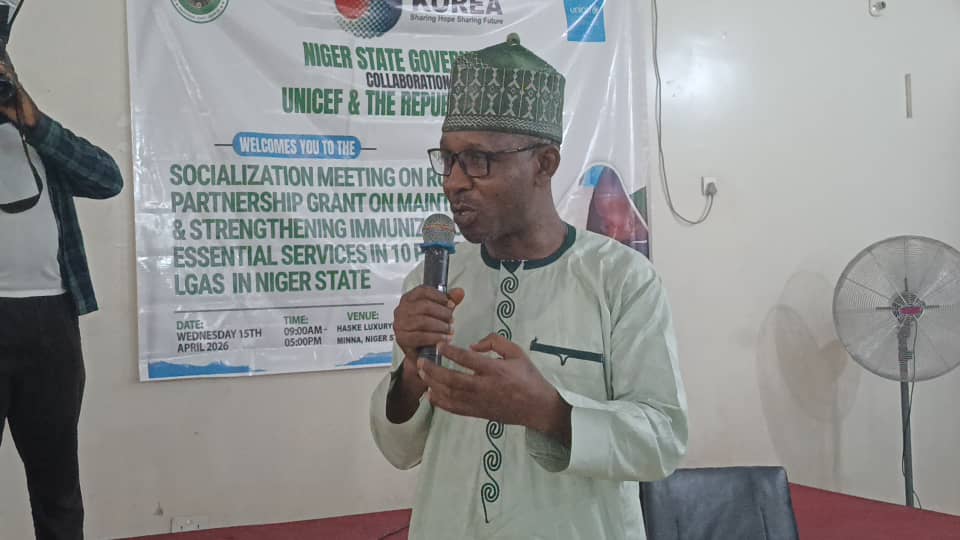
Niger state Commissioner for Health, Dr. Murtala Bagana, disclosed this during Socialization meeting on Republic of Korea (ROK)-United Nation's Children Emergency Fund (UNICEF) partnership grant on maintaining and Strengthening Immunization and Essential Services across the ten priotized LGAs in the state.
The Commissioner, represented by the Permanent Secretary of the Ministry, Dr. Abdullahi Imam, blamed the trend on insecurity caused by the activities of Boko-Haram/armed bandits and the number of hard to reach communities due to bad terrain.
While commending the UNICEF, and the Republic of Korea for the grant, the Commissioner urged the beneficiaries to jealously guard the programme towards strengthening both routine immunization and outreaches at the grassroots level.
Lamenting the negative impact of insecurity in the state the Commissioner said, “As a state, we are doing everything possible to ensure insecurity is curbed. We can all see the negative impact of the activities of armed bandits which has been a source of worry to everyone".
“It is not enough to plan for zero dose. Let us plan so that there will be no zero doses because every child that is not immunized is exposed childhood related diseases and a risk to other children.”
In his remarks, the Executive Director, Niger State Primary Health Care Development Agency, Dr. Inuwa Junaidu said the state is positioned in such a way that there are lots of challenges faced, including armed banditry especially as it is being surrounded by Zamfara, Kebbi, Kogi and Kaduna states.
Junaidu further hinted that, “All we need to do now, is to prioritize. Do a quick appraisal to identify LGAs that have contributed to the burden of zero-dose so that with this support from Korean government and the UNICEF we try to implement to ensure that all zero-doses are identified and then vaccinated within the eight months period”.
While expressing optimism that the adopted approach will go a long way in stemming the identified challenges, Junaidu said, "We will, identify, enumerate, vaccinate and as well ensure that the burden of zero dose is reduced to the barest minimal in Niger state".
In his goodwill message, the UNICEF representative, Health Specialist from the Kaduna Field Office, Dr. Ahmed Tsofo pointed out that, to actualise the implementation of the program, the agency will rely on the strong existing partnership with the state. “UNICEF will stand with Niger state government shoulder to shoulder to ensure that we do our best for this project to succeed.”
Tsofo however disclosed that, “Nigeria has the highest burden of zero dose globally of 2.1 million with Six states of Adamawa, Bauchi, FCT, Lagos Niger and Ogun identified. And some of these children are spread across the ten LGAs in Niger state".
He further argued that, “The coverage gap persistent outbreaks of vaccine preventable diseases like diphtheria, measles, cholera are part of the reasons for this support. But security challenge has been hindering us from reaching the targeted children”. NNL.